
We need to understand why our learners aren’t succeeding.
Reduce
Training Failure
Globally, companies are facing a training ROI crisis. The assumption: “If we provide training, people will learn.” The reality: “People can’t always access the learning.” This reflects a global shift — the challenge is no longer access to learning, but the ability to understand and apply it.
Get in touch
🇿🇦 South African
Reality
Training is delivered in English, but many learners are not fully comfortable learning in English. So, the real issue is comprehension, not capability.
Assessing learner readiness before training begins helps organisations place learners appropriately, improve completion rates, and increase training return on investment.
Our Insight
Training often fails before it even begins
Because:
The gap in learning programmes is often overlooked. Three factors should be aligned:
Kaleidoprax findings from Learning Resource Analysis Studies:
Learners averaged a comfort level of 7/8; training resources scored between 10 and 13 on the Gunning Fog Index; and facilitators’ comfort level was 7.
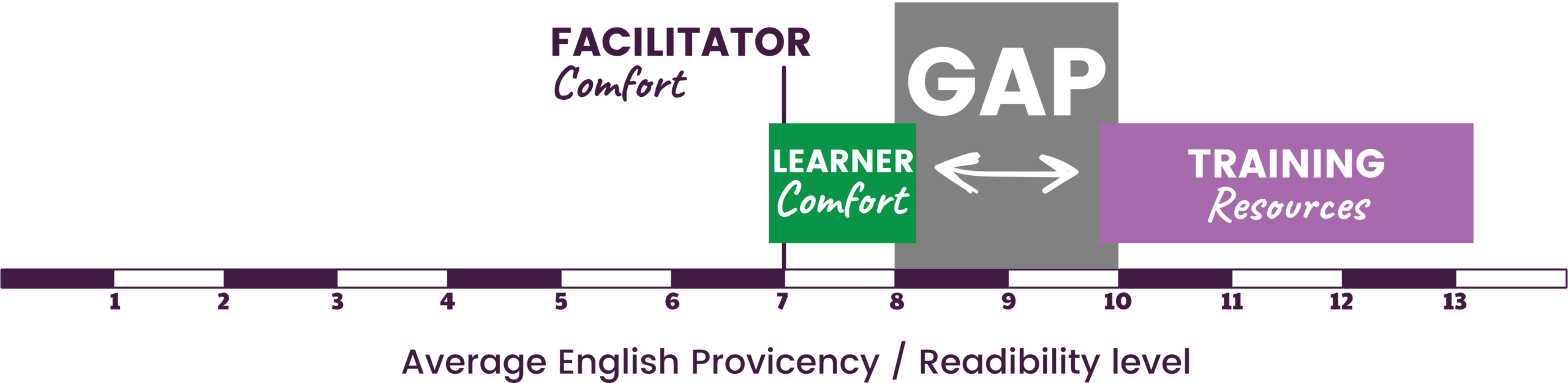
* Gunning’s Fog Index: Determines the readability index of text and compares it to the number of years of formal learning (in English) needed to understand information.
Impact
& Losses
The real cost of placing the wrong learner
Pre-selection isn’t an added expense — it’s protection against a much larger one. This tool shows how many candidates must be assessed to fill your programme at the right NQF level, and what that screening costs compared to the risk of learner drop-out.
Step 1 — select your NQF level
Percentages reflect eligible candidates from 2 991 NEET applicants assessed by Kaleidoprax over 5 years.
Stage 1 — how many candidates do you need to assess?
Candidate pool required — each dot represents one person assessed
Stage 2 — screening cost vs drop-out risk
Eligibility percentages are Kaleidoprax benchmarks derived from 2 991 NEET candidates assessed between 2019 and 2024, confirmed at the acceptable comfort threshold for second-language English users entering SETA-accredited programmes. Learnership cost is an estimated total including stipend, training provider fees, administration, and facilitator time. Figures are for planning purposes; actual results will vary by sector and programme design.
The Solution Pathway
We invest in training, but results are poor
Assess readiness before training
People attend but don’t apply what they’ve learned
Diagnose underlying capability gaps
We need better outcomes from training
Place learners into the right support pathway
Better training outcomes start here
Reduce training failure before it starts
Tell us what matters most to you
Explore a different pathway
Recruitment
Identify capability before hiring →
Workplace Communication
Strengthen communication where it matters most →
Workforce Insight
Turn workforce data into practical decisions →
Workforce Development
Build English capability for workplace success →
Future Readiness
Develop the human capabilities needed for the future of work →