
My staff are struggling with English at work
Workplace
Communication &
Performance
Globally, work is becoming more communication-heavy and more dependent on understanding information. At the same time, AI and automation are increasing complexity, raising the stakes for human interaction and clarity.
As work changes, communication is no longer a soft skill. It is a core performance requirement.
For organisations operating in multilingual environments, workplace English can be the difference between appearing capable and being able to perform consistently.
Get in touch
🇿🇦 South African
Reality
Only this person grew up speaking English as a first language.

In South Africa, English is not the first language for most employees.
Many employees
This creates
According to Census 2022, English was the language spoken most often in the household by 8.7% of South Africans. English may be the language of business, but it is not the first language for most South Africans.
When we compare the average English literacy level of 7,365 matriculated candidates aged 18 to 30 since 2020, this highlights the scale of the challenge.
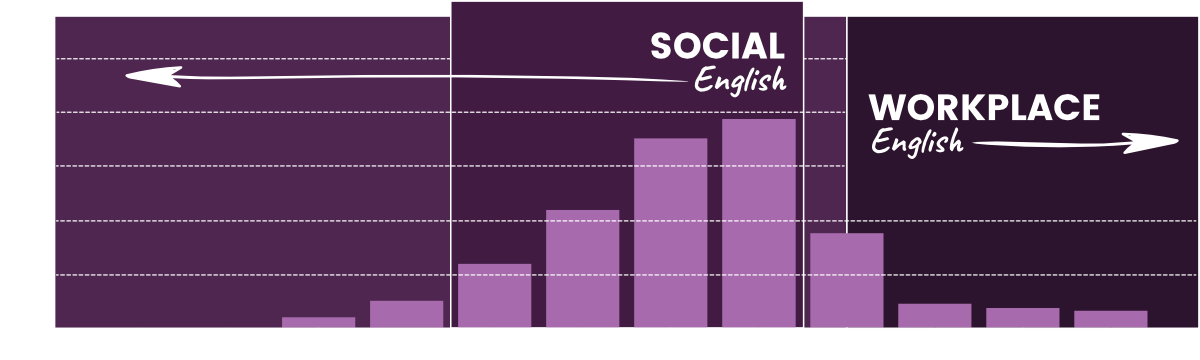
How the Scale works
Language develops along a spectrum of 12 formal milestones – one for each year of formal learning. Each milestone is determined by a set of outcomes expected of a native language user at that stage.
There’s a critical gap between sounding fluent and functioning effectively at work
Our Insight
Confidence is not just personality. It is built on
Impact
& Losses
Often misdiagnosed as attitude, lack of effort, or poor training
The Solution Pathway
We don’t know where communication is breaking down
Identify workplace communication gaps
Our staff seem capable, but performance is inconsistent
Assess workplace English capability
We need to improve communication in practical ways
Build practical workplace communication skills
People lack confidence or avoid speaking
Build confidence in workplace communication
Staff rely on basic or familiar language
Build workplace vocabulary and expression
Smarter communication starts here
Find out what’s really causing communication breakdowns
Tell us what matters most to you
Explore a different pathway
Recruitment
Identify capability before hiring. →
Workforce Insight
Turn workforce data into practical decisions. →
Reduce Training Failure
Measure readiness before learning begins →
Workforce Development
Build English capability for workplace success. →
Future Readiness
Develop the human capabilities needed for the future of work. →