
We want to build workplace English capability
Workforce
Development
— English Literacy
Globally, learning is shifting to continuous, applied development. Education systems are not keeping up with workplace needs. Graduates lack applied communication skills, and education no longer equals workplace readiness.
Get in touch
🇿🇦 South African
Reality
Many learners develop Social English but struggle to transition to Workplace English. This creates a ceiling where learners can communicate socially, but cannot progress in the workplace.
This gap is even bigger than it appears: many learners exit school without functional English literacy, yet enter workplaces or learnerships.
The Training ROI Crisis
Workplace English enables progression.
Our Insight
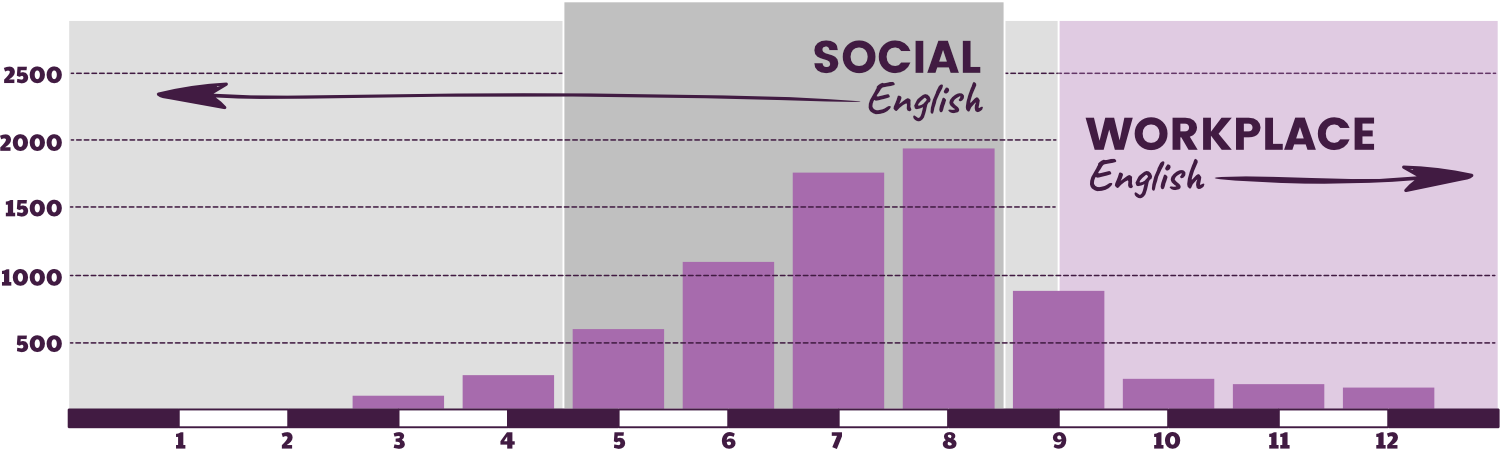
There is a critical shift from understanding everyday language → to thinking, reasoning, and performing in English at work. Most learners get stuck in between.
Social English enables participation. Workplace English enables progression.
English literacy level of 7,365 matriculated candidates aged 18 to 30 since 2020
How the Scale Works
Language develops along a spectrum of 12 formal milestones – one for each year of formal learning. Each milestone is determined by a set of outcomes expected of a native language user at that stage.
Basic numeracy level of 7,365 matriculated candidates aged 18 to 30 since 2020

Basic numeracy implies the essential skills needed for solving problems, processing information, MAKING DECISIONS and interpreting data. Being numerate is about appreciating number relationships and interpreting answers, and not just about doing calculations.
How the Scale Works
ELSA measures Numeracy on a scale up to grade 9 outcomes. Use a maths test to determine mastery of mathematical content beyond.
What it’s
Costing
You
The Solution Pathway
We don’t know where to start
Place learners at the correct level
Learners are not progressing
Provide structured development pathways
We need workplace-ready employees
Develop reasoning and communication skills
Your people’s potential starts here
Help your people move from basic to workplace-ready
Tell us what matters most to you
Explore a different pathway
Recruitment
Identify capability before hiring →
Workplace Communication
Strengthen communication where it matters most →
Workforce Insight
Turn workforce data into practical decisions. →
Reduce Training Failure
Measure readiness before learning begins →
Future Readiness
Develop the human capabilities needed for the future of work. →